Kimberly Ling
Instructional Designer & eLearning Developer
I design interactive, learner-centered experiences
I make complex ideas clear and engagingGuided by adult learning theory, accessibility principles, and ADDIE/SAM.
PROJECTS
Audit-Proof Your Documentation
Interactive eLearning module with scenario-based knowledge checks
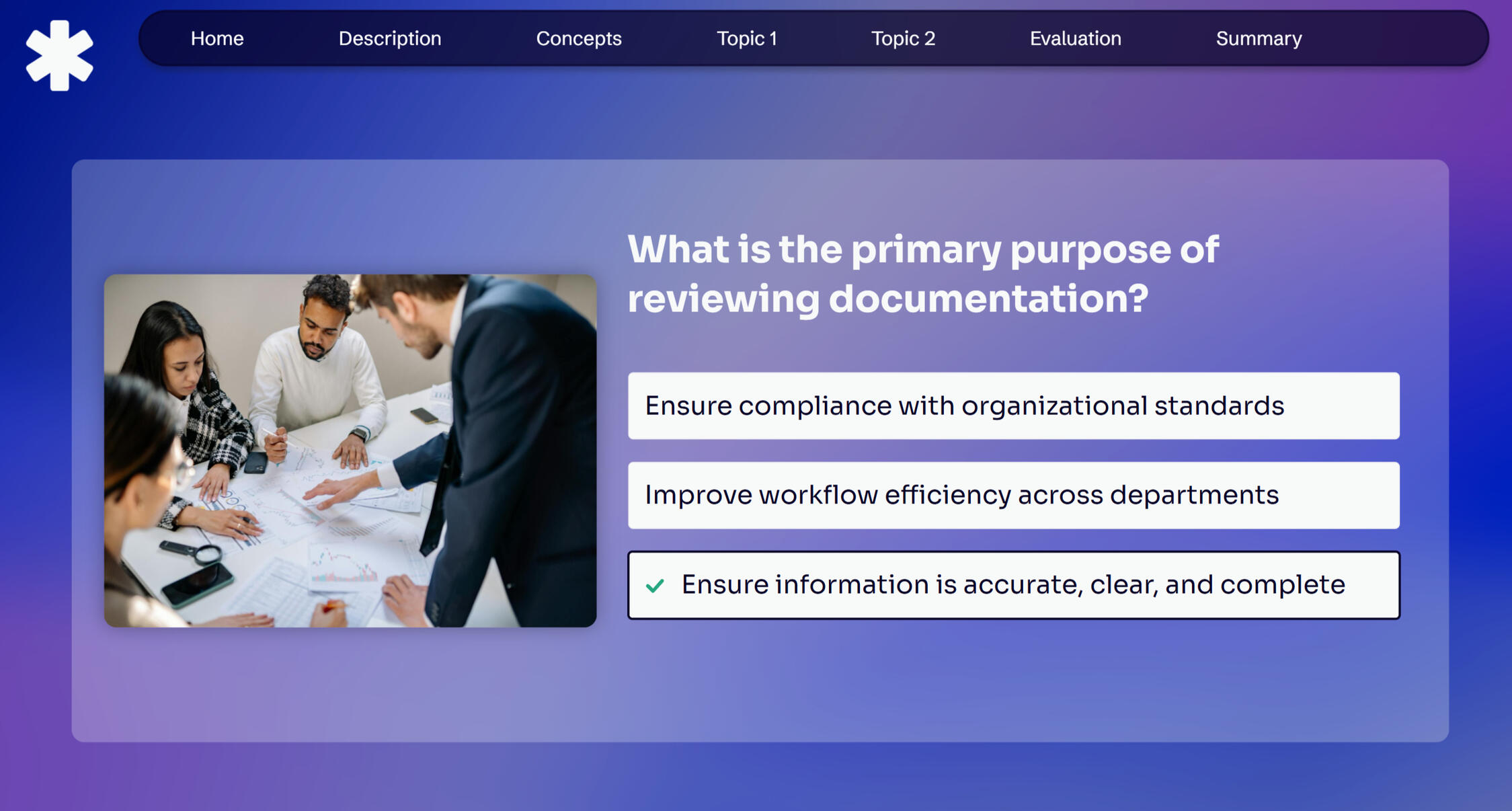
An interactive learning module designed to teach foundational auditing and documentation concepts. The course guides learners through key principles, real-world applications, and knowledge checks to reinforce accuracy, compliance, and process evaluation.Tools Used: Genially, AI-assisted content development toolsProcess: Designed and developed an interactive eLearning module using structured content, scenario-based learning, and knowledge checks to reinforce decision-making and real-world application.Impact: Designed to reduce documentation errors and improve compliance consistency. Supports faster onboarding and improved process adherence.
Additional Project
Digital Tools for Entrepreneurs: Designing Custom Decals for Business Branding
An end-to-end eLearning project demonstrating instructional design, development, and learner-centered decision-making.
A self-paced eLearning course designed to help small business owners use digital tools to create custom branding materials. The course guides learners through designing and producing decals using accessible technology and step-by-step workflows that support real-world application. Designed for small business owners with varying levels of technical experience.Tools Used: Articulate Rise 360, Canva, Filmora, Google Forms, AI-assisted content development toolsProcess: I developed this course to demonstrate the full instructional design process,
from learner analysis and storyboarding to prototyping,
accessibility checks, and final evaluation.Impact: The course translates business goals into practical learning, enabling users to build confidence and apply new skills directly to their branding and marketing efforts.
LEARNER PERSONAS

Understanding My Learners
These learner personas were developed for my featured eLearning course, Creative Technology for Entrepreneurs: Designing Custom Decals for Business Impact. The course helps small business owners and entrepreneurs learn how to design and produce custom vinyl decals using creative technology and software tools to enhance their branding and marketing. These personas represent the types of learners I designed the course for, guiding my content, tone, and design decisions throughout the project.
Persona 1: The Entrepreneur on a Budget

Alex Johnson (32), a creative entrepreneur learning to design custom decals to elevate their candle brand
● Background: Recently launched an Etsy shop selling handmade candles. Wants to add custom vinyl labels to packaging for a professional look.● Goals: Learn how to design and apply vinyl decals without outsourcing, so they can save money and build brand identity.● Challenges: Has little experience with design software or Cricut machines. Time is limited due to running the business full-time.● How This Course Helps: Provides clear, step-by-step instructions, minimizes trial-and-error, and helps Alex quickly apply decals to scale their business.
Persona 2: The Safety & Operations Coordinator

Jordan Wells (41), a Safety and Operations Coordinator designing clear, compliant decals to promote workplace safety.
● Background: Works as a Safety and Operations Coordinator for a mid-sized company, responsible for workplace signage, compliance, and employee safety training..● Goals: Learn how to design clear, visually engaging decals and instructional signs that communicate safety information effectively.● Challenges: Limited design experience and struggles to make safety materials visually appealing while still compliant with regulations.● How This Course Helps: Provides accessible, step-by-step guidance for creating professional safety decals and labels using simple eLearning principles and design tools, improving clarity, compliance, and employee engagement.
Persona 3: The Supplier to Other Businesses

David Chen (39), a print shop owner expanding his services by creating branded decals for other small businesses.
● Background: Runs a small print and design side business. Looking to expand services by creating custom vinyl products that support other business owners, such as thank-you stickers, branded labels, and packaging decals.● Goals: Offer affordable, personalized decals that local shops and online sellers can buy in bulk to enhance their customer experience.● Challenges: Wants to ensure professional quality but doesn’t have the budget for expensive industrial printing equipment. Needs efficient workflows to meet client orders on time.● How This Course Helps: Teaches David how to select the right vinyl, set up Cricut software for bulk production, and apply decals consistently, turning his skills into a service that supports fellow entrepreneurs.
Persona 4: The Small Business Owner Expanding Services

Patty Miller (47), a boutique owner using custom vinyl designs to create unique displays and enhance customer experience.
● Background: Owns a small boutique selling home décor and gifts. Wants to create custom vinyl window displays, wall art, and packaging to make the shop stand out.● Goals: Gain confidence using Cricut software to create unique, branded designs in-house. Increase revenue by offering personalized decals to customers.● Challenges: Feels intimidated by technology and overwhelmed with day-to-day business operations. Needs a straightforward, practical learning experience.● How This Course Helps: Simplifies Cricut setup, breaks down complex tasks, and focuses on business-oriented applications to give Maria confidence and creative control.
Together, these personas ensured the course addressed diverse learner needs, from small business owners to creative entrepreneurs, and guided decisions around content structure, accessibility, and tool selection.
About
I am an Instructional Designer and Learning Content Developer with a passion for creating clear, user-focused learning experiences that help people confidently navigate systems and workflows.I specialize in translating complex processes into structured, easy-to-understand content, including step-by-step guides, eLearning modules, and interactive learning materials. My approach combines instructional design principles, user-centered thinking, and continuous improvement through feedback and evaluation.I enjoy designing learning experiences that are accessible, practical, and engaging, with a focus on helping users build confidence and apply what they learn in real-world situations.
Skills & Expertise:
Instructional Design & Adult Learning Theory • Accessibility & Inclusive E-Learning Design • AI Applications in Learning Design • ADDIE & SAM Models • Storyboarding & Prototyping • Articulate Rise 360 & Storyline • Camtasia & Whiteboard Animation • Assessment & Rubric Design • Evaluation & Feedback (Kirkpatrick Model) • LMS Administration & Virtual Training Delivery
DIGITAL BADGES & CERTIFICATIONS
As part of the University of Washington’s Certificate in E-Learning and Instructional Design, I earned a series of digital badges that demonstrate my growing expertise in instructional design and e-learning development.Click each badge below to learn more about the skills and knowledge I’ve gained and how they can be applied to create effective, learner-centered experiences.


Portfolio
Design and Development
Welcome to my portfolio! Here, you’ll find examples of my instructional design projects that showcase both the finished learning experiences and the behind-the-scenes process that brought them to life.One featured project is:
Designing User-Focused Learning Content for Digital Tools
(E-learning course built in Articulate Rise)
This course teaches small business owners how to design and create custom decals to strengthen their branding and stand out in their communities. Alongside the course itself, I’ve included sections on my design and development process, from analyzing learner needs and drafting storyboards to building interactive elements and refining the final product.Below, you’ll find a walkthrough of my process, organized by the ADDIE model and paired with an evaluation plan based on Kirkpatrick’s framework. Each section highlights the decisions I made and the strategies I used to bring this course to life.
Analysis: E-Learning Proposal
This proposal reflects the (A) Analysis phase of ADDIE because it clearly identifies the problem, the target audience, and the learning need. The project defines who the learners are (entrepreneurs and small business owners, with room for hobbyists), why they need the course (to build brand presence and support business goals), and the learning objectives (guiding them through creating vinyl decals from setup to application). It also outlines the scope of the course and contextual factors, which provides a foundation for the later design and development stages.
Part 1: Project Scope
The whole course is self-paced for beginners who want to learn how to make decals using a Cricut machine and will cover the full processing from the program setup to designing and applying the vinyl decals in 5 parts.
Part 2: Background
Gap: Learning to use the Cricut software and cutting/weeding often requires trial and error. Improper cutting and weeding and application of the vinyl decal can lead to wasted vinyl.Audience: Individuals who are interested in designing decals for personal use, a new hobby, starting a decal business, gift giving, DIY projects.Training Goal: After successfully completing this course, learners will be able to confidently design their own decals from start to finish, from choosing the right materials and using the Cricut Design Software, to applying and troubleshooting their designs.
Part 3: Design Approach
Format/Structure: This e-Learning will be a course that is fully self paced and asynchronous.Possible Technology: I’m not sure yet, but possibly Rise.
Part 4: Implementation
Context (where, when, how): Learners will be able to take the course on a computer and possibly tablet. Once launched, the course will be available for learners to enroll and complete at any time during the year.Org Considerations: This course does not involve organizations at this time.
To better understand my target audience, I developed three learner personas representing diverse small business owners. These personas helped guide my design decisions and course tone.
Design: Storyboard
The storyboard represents the (D) Design phase because it translates learning objectives into a clear course structure, mapping out the sequence of modules, activities, and assessments. It serves as a blueprint to ensure flow, alignment, and engagement before development begins.
➤ Savvy Start
During the Savvy Start, I used peer feedback to refine my storyboard and flow. For example:I moved "Materials & Tools Needed" before “Overview of the Cricut Design Software” so learners could prepare resources first.
I separated the two tutorial videos (cutting/weeding and transferring/applying) and added knowledge check quizzes in between. This reduced cognitive load and kept learners engaged.
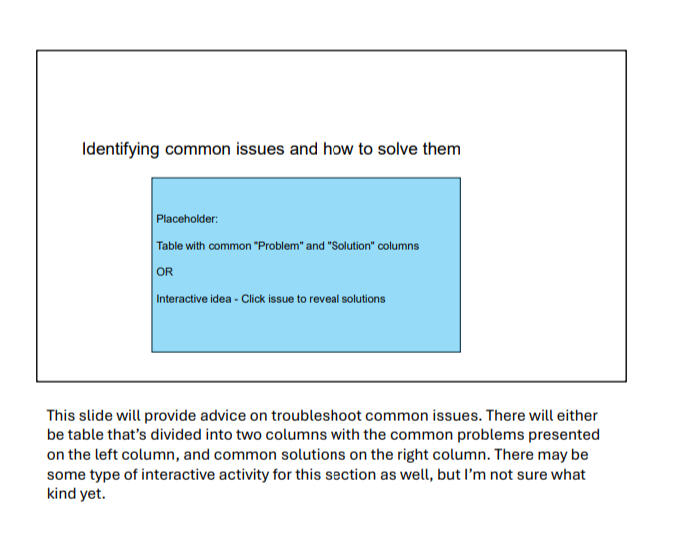
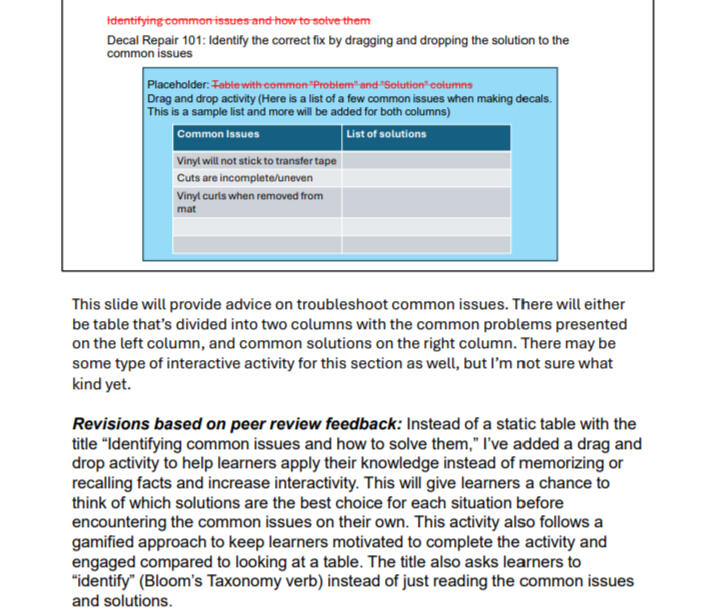
I revised activity wording with Bloom’s Taxonomy verbs (e.g., “Identify the correct fix” instead of “Identifying common issues”) to make objectives more measurable and action-driven.
This early design feedback helped me improve clarity, engagement, and instructional alignment before development.
➤ Storyboard Iterations
Development: Work Plan
The Work Plan represents the (D) Development phase of ADDIE because it takes the storyboard and design concepts and turns them into a structured plan for production. In this phase, I outlined the project scope, learning goals, elements to be developed, and the timeline. This plan acts as a roadmap for building the e-learning course, ensuring that each module is developed systematically and aligned with the course’s instructional objectives.
➤ Topics and Goals
This project is a self-paced, asynchronous e-learning course that teaches entrepreneurs how to design their own custom vinyl decals using the Cricut Design Space software. The course is designed for small business owners, creatives, and hobbyists who want to enhance their brand presence with personalized visuals like product packaging, labels, and storefront graphics.The primary goal is to provide learners with practical, hands-on training that allows them to apply creative technology to support branding and business operations. By the end of the course, learners will have the tools and confidence to design, cut, and apply custom decals for real-world business or personal use.
➤ Proposed Elements
The course is structured into the following elements:Optional Community Gallery – Learners can share their work via QR code in an online gallery.Welcome and Introduction – Overview of vinyl decals and their uses in business.Materials & Tools Needed – Includes a downloadable checklist.Overview of the Cricut Design Software – Guided introduction to the program.Practice: Selecting & Importing Designs – Learners use sample file downloads and practice importing.Cutting and Application – Instructional videos and interactive knowledge checks.Troubleshooting Common Issues – Drag-and-drop activity plus a downloadable troubleshooting checklist.Knowledge Check/Assessment – Practice questions with unlimited attempts.Final Project & Reflection – Learners upload their decal project and a written reflection.
➤ Timeline
Module 1 – Welcome and Introduction: July 16Module 2 – Materials & Tools: July 16Module 3 – Cricut Design Software Overview: July 27Module 4 – Cutting & Weeding, Application (film videos): July 27Module 5 – Troubleshooting (interactive activity): August 3Module 6 – Final Project Submission & Reflection: August 10Full Course Review – August 17
Implementation: Working Proof
The working proof represents the (I) Implementation phase because it demonstrates how the designed learning activities are brought to life in a functional e-learning environment. For example, I created an interactive drag-and-drop activity where learners complete sentences by selecting the correct tool (e.g., dragging “scraper” into the blank). This shows how the planned design translates into a live, testable component of the course, giving learners a chance to apply knowledge in a hands-on way.
➤ E-Learning
This course was built in Articulate Rise 360, a modern e-learning platform that specializes in creating responsive, user-friendly courses. Rise was chosen for its clean design, accessibility across devices, and interactive features such as knowledge checks, scenario-based learning, and multimedia integration. These tools allowed me to create an engaging experience that blends practical instruction with interactive application. The scope of the live e-learning includes seven lessons that guide learners through the full process of creating custom vinyl decals, from understanding materials and software setup to hands-on demonstrations, troubleshooting, and a final project submission. Optional community-sharing features and feedback surveys were also incorporated to encourage collaboration and continuous improvement
Evaluation
The (E) Evaluation phase in ADDIE ensures that the learning experience is both effective and continuously improved. For my project, evaluation was built into multiple points of the course to measure not just learner satisfaction but also learning outcomes, behavior changes, and potential business impact. Using Kirkpatrick’s Four Levels of Evaluation, I integrated tools such as knowledge checks, scenario-based activities, project submissions, and a final feedback survey.This phase demonstrates how data (both quantitative such as quiz scores, project completion rates) and qualitative (learner reflections, survey feedback) can be collected and analyzed to determine whether the course is meeting its intended goals. It also allows for iterative refinement, ensuring the e-learning remains relevant, engaging, and aligned with learner and organizational needs.
➤ E-Learning Goals
● Ensure that the course is engaging, relevant, and easy to follow for entrepreneurs and hobbyists.● Measure the effectiveness of instructional design choices (e.g., clarity of lessons, usefulness of videos, success of interactivities).● Identify whether the course structure (modules, activities, project submission, etc.) supports knowledge retention and application.● Collect data to guide continuous improvement of the course content, interactivity, and delivery platform (Articulate Rise).● Assess the course’s impact on learner confidence and satisfaction, as well as whether it supports business-related goals (like branding through decals).
➤ Kirkpatrick Levels
● Level 1: Reaction
Tool: End-of-course feedback survey (Google Forms).
Purpose: Measure learner satisfaction, perceived relevance, and ease of use of the Rise course.
Example Question: “How confident do you feel about applying decals after completing this course?”● Level 2: Learning
Tools: Knowledge quiz (multiple-choice, drag-and-drop), scenario-based troubleshooting activity.
Purpose: Measure increase in knowledge and skill (e.g., understanding of Cricut Design Space, correct use of tools, solving decal issues).
Example Measure: % of correct answers on quiz/activities.● Level 3: Behavior
Tools: Final project submission (photo of decal + reflection). Optional community gallery uploads.
Purpose: Assess whether learners can apply skills in real-world contexts (cutting, weeding, applying decals).
Example Measure: Quality of project submissions, self-reported reflection on how they applied what they learned.● Level 4: Results
Tools: Long-term survey follow-up (optional), or initial course survey questions about intended business use.
Purpose: Determine the impact of the course on business or personal goals, such as using decals for branding, creating products, or enhancing creativity.
Example Measure: Learners reporting increased ability to create professional decals, or positive outcomes like improved branding or customer engagement.
➤ Assessment Techniques and Tools
Techniques
There will be no formal grading. Since the focus is on skill development and creativity, learners will receive a rubric and be able to grade themselves on their final project. The goal of the learning is to support learners on mastery and confidence. Learners will also receive formative assessment feedback during their knowledge checks and practice activities throughout the course so they can see how well they’re progressing step by step. They will also participate in a summative assessment at the end where they’ll be able to complete and upload their final decal project that demonstrates creativity and technical accuracy. For the summative assessment, they will also receive feedback so they know whether they have successfully completed the course.To address reliability, learners will be guided by a rubric that provides clear criteria to ensure that expectations are consistent, reliable, and repeatable in scoring. To ensure validity of the tests, the assessments will directly align with the course objectives so that learners can demonstrate the skills emphasized. I will test both declarative (example: describing and identifying the tools and the steps when using the Software) and procedural knowledge (example: designing, weeding, and correctly applying their decal). Both declarative and procedural knowledge will be tested because declarative knowledge helps learners demonstrate the “what and why,” while procedural knowledge helps to demonstrate how skill is done. Without having both, learners would not be able to complete their projects accurately.The assessment tool captures both qualitative and quantitative data. Both are appropriate for my course because quantitative data (example: knowledge quiz scores) demonstrates whether the learners meet the learning objectives, and qualitative data (example: reflection, instructor feedback, self-assessment using a rubric, focus on design creativity, and accuracy on execution) demonstrate how well learners are applying the knowledge and skills in the real world. Having both gives a fuller picture of course effectiveness.Since this course is self-paced, there will be no live instructor. Learners will receive ongoing feedback, including immediate feedback on assessments and a rubric to self-assess their final project submission. I (instructor) will also provide feedback on learners’ final decal project submission.
Tools
Quizzes will be graded automatically and provide both objective and quantitative data on learners’ knowledge and skill learned. An example includes multiple choice questions that have learners select which type of tool is needed for a specific step. This will be created using google forms https://workspace.google.com/products/forms/. This tool is the best for my course because it’s simple, effective, and a great way to provide immediate feedback for learners.There will be a self assessment at the end of the course where learners upload their final decal project on google forms using the upload option. For example, learners will submit a written reflection on the process and any challenges they’ve encountered on google forms https://workspace.google.com/products/forms/. This tool is the best choice for my course because it makes it easy for learners to upload their final project and reflection in one setting. Google forms provides a centralized way for learners to complete their submissions in a simple way, and requires no extra set up for easy review. Learners can share their work in an efficient manner, and I will be able to evaluate both submissions in one place.Feedback surveys will be provided at the midpoint and end of the course using rise feedback blocks. I will embed open-response questions directly into Rise for learners to respond to https://www.articulate.com/360/rise/ . This tool is the best choice for my course because it ensures seamless participation and increases response rates since the course will be created in Rise. For example, I could ask learners to rate how helpful the step by step Cricut Cutting Video was for their learning experience on a scale from 1 to 5, with 5 being the most helpful.
Evaluation Plan
To assess the effectiveness of my course, I will examine several different variables across Kirkpatrick’s Levels of Evaluation. At Levels 1 and 2, I will focus on learner reaction via surveys and feedback forms as well as learning via quiz scores, completion of activities, and accuracy/quality of final decal project submission. At Levels 3 and 4, the focus will be on behavior and results (whether learners apply their new decal design skills in real life context such as demonstrating Cricut proficiency into business use) and whether the course was able to contribute to meaningful outcomes such as overall improved confidence and business growth.I will use built-in Rise survey blocks, Google Forms, and quiz data to gather immediate learner reactions and knowledge retention for Levels 1 and 2. I will use final project submissions (Google Forms), optional peer sharing platforms (Rise), and end-of-course surveys (Rise) for Levels 3 and 4 for evidence of long-term impact and skill transfer.Data for Levels 1 and 2 will be collected during the course and immediately after the course via surveys, quizzes, and final reflection at the end. Data for Level 3 will be gathered through final project submissions at the end of the course (application in real world). Data for Level 4 will be gathered at the end of the course and again ~ 1month later, via follow up surveys to help assess long term application.Objective data will include rubric-based evaluations of projects and knowledge quiz scores. Subjective data will include written reflections, survey responses, and self evaluation of their final project.Because the course is self-paced, data will be conducted on a rolling basis and be reviewed/used continuously (planning for every six months). Data from Levels 1 and 2 will be used for short-term improvements, such as clarifying any confusing course context or adjusting quiz related items. Data from Levels 3 and 4 will guide longer term course refinements such as adding additional support in areas where learners may struggle most. This ensures that assessment results not only focus on demonstrated achieved outcomes, but also strives for continuous course improvements.
➤ Questionnaire
Level 1: Reaction (Learner Satisfaction)● How easy was it to navigate through the course (1–5 scale)?
● How engaging did you find the activities (drag-and-drop, scenarios, etc.)?
● What part of the course did you enjoy the most?Level 2: Learning (Knowledge/Skills Gained)● After completing this course, how confident do you feel in your ability to create vinyl decals? (1–5 scale)
● What is one new skill or concept you learned that you didn’t know before?Level 3: Behavior (Application)● Do you feel prepared to apply what you learned to your own business or personal project? (Yes/No + Explain)
● Have you already tried applying the skills from this course? If yes, what was the outcome?Level 4: Results (Impact)● Would you recommend this course to other entrepreneurs or hobbyists? Why or why not?
● How do you expect this course to impact your business, brand, or personal goals?
Summary of work accomplished
1. Content: Designing User-Focused Learning Content for Digital Tools, is a course that teaches entrepreneurs and small business owners how to create custom vinyl decals from the beginning to final application. Topics include Introduction to Vinyl Decals, Materials & Tools Needed, and an overview of the Cricut Design Software.2. Audience: While the course is geared towards entrepreneurs and small business owners, creative professionals, hobbyists, and DIY learners interested in decal-making across industries such as fitness, wellness, artisan products, and branding are welcome to take the course.3. Purpose: The purpose is to empower learners to use creative technology to build a stronger brand presence. Through hands-on instructions in the complete decal-making process, learners can design personalized visuals (e.g., product packaging, labels, storefront graphics) that elevate business identity and amplify marketing impact.4. Needs analysis: Small business owners frequently struggle when it comes to finding affordable and accessible options for brand identity. Through decal-making, learners gain a creative and budget-friendly solution for customizing branding. Analysis of peers, mentors, combined with instructional design principles highlighted the need for a structured, meaningful, engaging, and skills-driven course tailored to business applications.5. Accessibility and Accommodation: Designed in Articulate Rise, the course complies with Section 508 and WCAG 2.1 accessibility standards. Features such as transcripts for videos, accessible color contrast, and screen-reader support are supported throughout the lessons to ensure an inclusive learning experience.5. Standard Compliance: The course is able to be exported in SCORM format, which allows for smooth integration into various LMS platforms.6. Scope of work: The full storyboard and course prototype, 7 course lessons, interactive activities, and summative assessment have been completed. The remaining items that I plan to refine further include pilot testing, visual polish (add more photos, graphics, and design accents), and additional video content such as a step-by-step demonstration with voiceover.8. Media and tools used: Articulate Rise was used to create this course. Media includes video demonstration (cutting, weeding, applying decals), interactive scenarios, Google Forms (project uploads & evaluation survey), and the option to upload photos of their decal project to the community gallery using Padlet. Rise allows for accessibility, responsive and engaging design, and interactivity. Google Forms provides simple and easy submission. Lastly, YouTube allows for visual demonstration enhancement.9. Budget: While I designed the E-Learning Course, the following are potential costs associated with professional development and future delivery:
- Articulate: $1,199
- Camera/Audio production fees: $50010. Assessment strategies and tools:- Formative: Knowledge checks include quizzes, scenario-based exercises, and interactive activities
- Summative: Final project submission (Learners are asked to upload a photo of their final decal application + reflection via Google Forms)
- Evaluation: Submission of evaluation feedback surveys via Google Forms, self-scoring using a rubric for learners, and Kirkpatrick’s Four Levels
- Pilot Testing: A small test group survey will be conducted to collect feedback on overall impact and usability before official launch
Contact

Have a project in mind or curious about my work? I’d be happy to connect and share more. please contact me at [email protected].Thank you!